
Refinery shutdowns, also known as turnarounds, are among the most critical maintenance events in the oil and gas industry. Every hour of downtime directly impacts production, operational efficiency, and profitability. To minimize delays and maximize plant reliability, refineries increasingly rely on advanced hydroblasting applications for fast, safe, and efficient industrial cleaning.
Hydroblasting has become an essential solution during refinery shutdown maintenance because it delivers high cleaning efficiency, reduces manual labor requirements, and shortens turnaround durations significantly.
What is Hydroblasting in Refinery Maintenance?
Hydroblasting is a high-pressure water jetting process used to remove scale, coke deposits, sludge, fouling, coatings, and contaminants from industrial equipment surfaces. Ultra-high-pressure hydroblasting systems can operate at pressures ranging from 500 bar to over 2800 bar depending on the application.
In refinery shutdown projects, hydroblasting is widely used for cleaning:
Heat exchangers
Boilers
Reactors
Pipelines
Storage tanks
Condensers
Furnaces
Surface preparation applications
Hydrocarbon processing equipment
Unlike chemical cleaning or abrasive blasting, hydroblasting uses only water pressure, making it an environmentally safer and highly effective cleaning method.
Importance of Fast Turnarounds in Refineries
A refinery turnaround involves planned shutdowns for inspection, repair, cleaning, and equipment upgrades. Since refinery downtime costs can reach millions of dollars per day, reducing turnaround time is a top operational priority.
The key objectives during shutdown maintenance include:
Minimizing downtime
Improving maintenance efficiency
Enhancing worker safety
Reducing operational costs
Increasing equipment reliability
Returning the plant to production faster
This is where hydroblasting technology provides a major advantage.
Key Hydroblasting Applications During Refinery Shutdowns
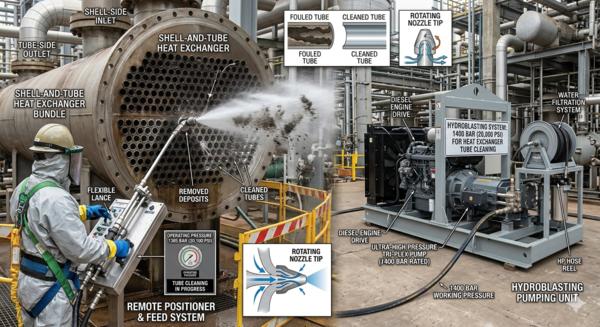
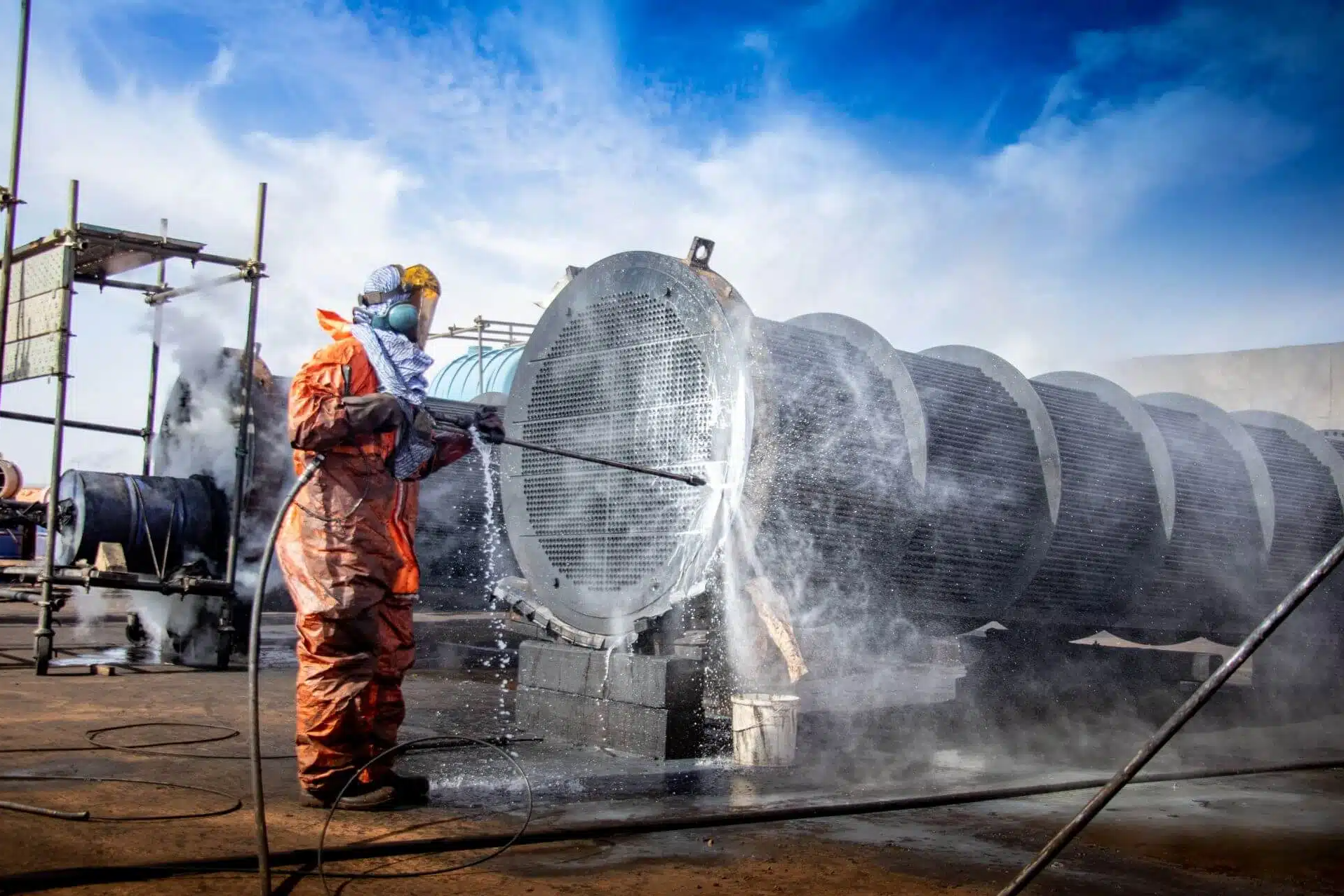
1. Heat Exchanger Tube Cleaning
Heat exchangers are highly susceptible to fouling, scaling, and hydrocarbon deposits. Reduced heat transfer efficiency directly impacts refinery productivity.
High-pressure hydroblasting effectively removes:
Hard scale deposits
Coke buildup
Sludge accumulation
Corrosion residues
Benefits include:
Faster tube cleaning
Improved heat transfer efficiency
Reduced equipment downtime
Better inspection accessibility
Automated tube cleaning systems further increase productivity while minimizing operator exposure.
2. Reactor and Vessel Cleaning
Refinery reactors and pressure vessels accumulate heavy hydrocarbon residues and catalyst deposits over time. Manual cleaning can be slow, hazardous, and labor-intensive.
Hydroblasting systems enable:
Rapid residue removal
Internal vessel cleaning
Safe confined-space operations
Reduced manual entry requirements
Using remotely operated hydroblasting tools significantly improves worker safety during shutdown maintenance.
3. Tank Cleaning Applications
Storage tanks often require complete cleaning before inspection, repair, or product changeover.
Hydroblasting helps remove:
Oil sludge
Wax buildup
Chemical residues
Corrosion layers
Advantages include:
Reduced cleaning time
Lower manpower dependency
Better surface preparation quality
Faster inspection readiness
Automated tank cleaning systems also reduce hazardous exposure for maintenance crews.
4. Pipeline and Process Line Cleaning
Blocked or fouled pipelines can severely affect refinery operations. Hydroblasting provides efficient internal cleaning for process piping and transfer lines.
Applications include:
Descaling pipelines
Removing hardened deposits
Cleaning bends and elbows
Restoring flow efficiency
Ultra-high-pressure jetting ensures thorough cleaning even in difficult-to-access sections.
5. Surface Preparation for Maintenance and Coating
During shutdowns, many refinery structures require repainting, coating removal, or corrosion treatment.
Hydroblasting is highly effective for:
Surface preparation
Coating removal
Rust removal
Paint stripping
Compared to abrasive blasting, hydroblasting generates less dust and offers environmentally friendly surface treatment.
How Hydroblasting Reduces Manpower Requirements
One of the biggest advantages of modern hydroblasting systems is manpower reduction through automation and remote operation.
Traditional manual cleaning methods require large maintenance teams and extended working hours. In contrast, automated hydroblasting systems allow:
Fewer operators per cleaning task
Remote-controlled operations
Reduced confined-space entry
Faster cleaning cycles
Improved operational consistency
This not only lowers labor costs but also reduces worker fatigue and improves shutdown planning efficiency.
Faster Maintenance Completion with Hydroblasting
Hydroblasting significantly accelerates refinery maintenance schedules by improving cleaning speed and reducing setup time.
Key factors contributing to faster completion include:
High Cleaning Efficiency
Ultra-high-pressure water jets quickly remove stubborn deposits without damaging equipment surfaces.
Reduced Equipment Downtime
Faster cleaning allows inspection and repair teams to begin work sooner.
Minimal Secondary Cleanup
Hydroblasting produces less secondary waste compared to abrasive methods.
Automation Integration
Robotic and automated systems improve operational speed while maintaining consistent cleaning quality.
Multi-Application Flexibility
The same hydroblasting equipment can be used across multiple refinery maintenance applications.
Safety Advantages of Hydroblasting During Shutdowns
Safety is a major concern during refinery turnarounds due to confined spaces, hazardous materials, and high-temperature environments.
Modern hydroblasting systems improve safety through:
Remote operation capabilities
Reduced manual handling
Lower chemical exposure
Minimal dust generation
Reduced confined-space entry
Advanced automated tooling further minimizes operator risk during high-pressure cleaning operations.
Environmental Benefits of Hydroblasting
Refineries are increasingly adopting environmentally responsible maintenance practices. Hydroblasting supports sustainability goals by reducing chemical usage and airborne contaminants.
Environmental advantages include:
No harsh chemicals required
Reduced dust emissions
Lower waste generation
Water recycling compatibility
Eco-friendly cleaning process
These benefits make hydroblasting a preferred industrial cleaning solution for modern refinery operations.
Choosing the Right Hydroblasting Partner for Refinery Shutdowns
Successful refinery turnaround projects depend heavily on selecting experienced hydroblasting specialists with advanced equipment and trained operators.
Important factors include:
Ultra-high-pressure equipment capability
Automated hydroblasting systems
Skilled technical manpower
Safety compliance standards
Fast mobilization capability
Proven refinery maintenance experience
A reliable hydroblasting partner can help refineries reduce shutdown duration, optimize maintenance operations, and improve overall plant efficiency.